

Resumen
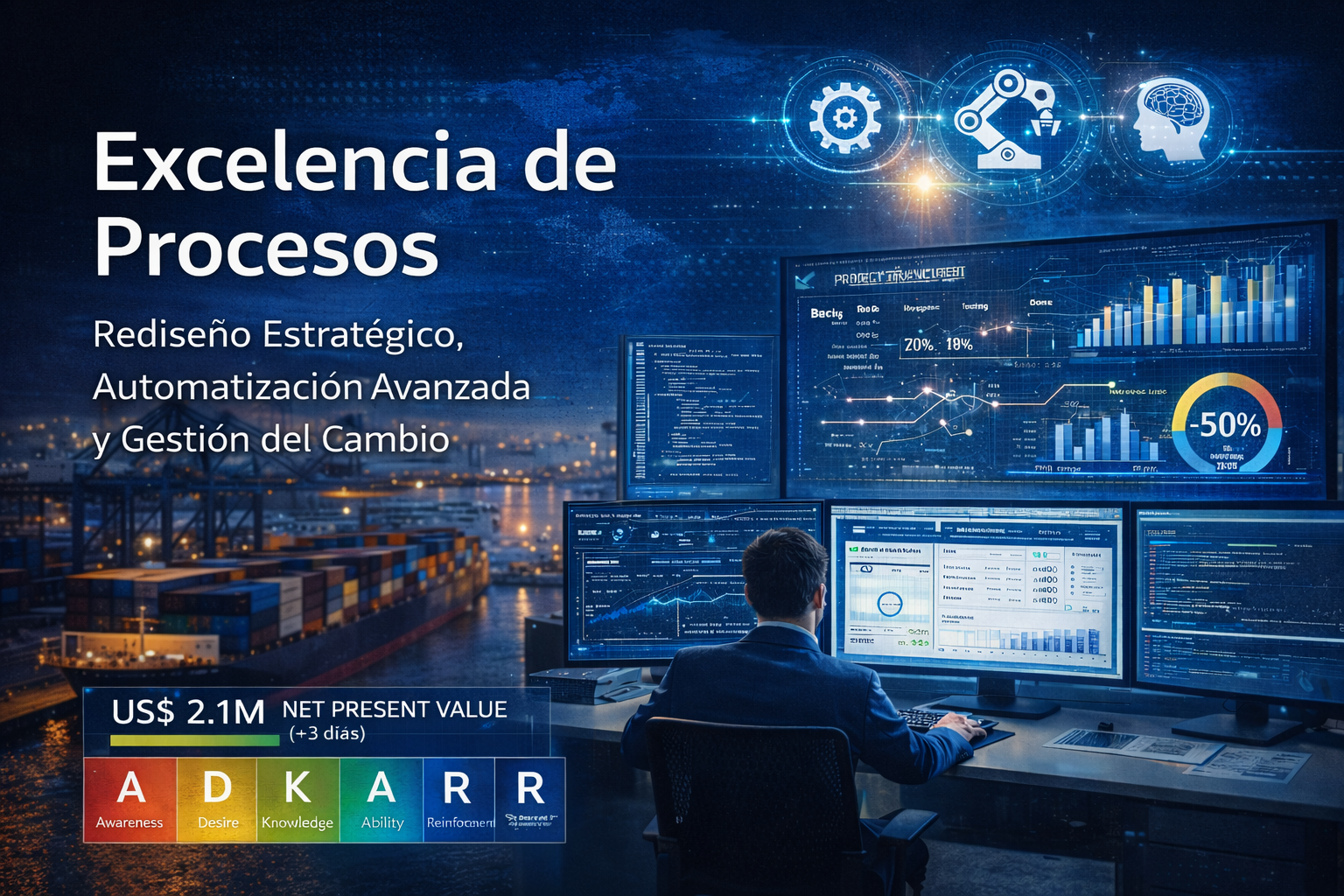
La excelencia operativa en el entorno empresarial actual exige una transición de modelos rígidos a metodologías ágiles y soluciones tecnológicas de vanguardia. Este artículo integra el marco teórico del ciclo de vida de la gestión de procesos de negocio (BPM) con el enfoque práctico de la Automatización Robótica de Procesos (RPA) y la gestión del cambio. Se examina la importancia de superar errores estructurales como la falta de formalización y la dependencia de procesos manuales, utilizando como eje central el caso de éxito de Agrosuper. En dicho caso, el rediseño y la automatización del área de Revenue Management permitieron una reducción del 50% en los tiempos de ejecución y un impacto financiero masivo. Finalmente, se concluye que la verdadera transformación no es solo técnica, sino humana, requiriendo marcos como el modelo ADKAR para garantizar que los nuevos procesos sean adoptados y sostenibles en el tiempo.
——————————————————————————–
The Strategic Imperative of Process Transformation
In a globalized market, process improvement has evolved from an operational task into a primary strategic initiative for managers seeking to transform their operations through digitalization. Organizations face constant pressure to eliminate bottlenecks, reduce expenses, and improve both internal and external customer satisfaction. True process excellence requires moving beyond traditional maintenance to innovate and create new ways of operating, such as managing orders or manufacturing products more efficiently.
Theoretical Foundations: The BPM Lifecycle and Mapping
Implementing Business Process Management (BPM) should be guided by a life cycle model to ensure consistency with organizational goals. This cycle typically synthesizes four essential phases: analysis and design, configuration, execution, and evaluation. A critical tool in this framework is the mapping of «As-Is» (current state) and «To-Be» (future optimized state) processes. Understanding the «As-Is» state is vital to identify redundancies and inefficiencies, while the «To-Be» model provides a roadmap for an agile infrastructure.
Overcoming Management Errors: Formalization and Systematization
Many process initiatives fail due to two fundamental structural errors: lack of formalization and lack of systematization. Without formalized processes, team members perform activities inconsistently, preventing the organization from owning its functional know-how. Furthermore, a lack of systematization—such as relying on isolated spreadsheets instead of integrated information systems—leads to massive rework and operational risk.
Agility and Innovation: Design Thinking and Scrum
To respond to rapidly changing customer expectations, organizations are adopting hybrid methodologies. Integrating Design Thinking for creative problem-solving with Scrum for agile implementation allows teams to release «minimum viable» versions of a process and improve them iteratively. This approach reduces risk and increases adaptability, ensuring that companies do not wait for a «perfect» process before going to market.
The Technological Leap: BPMS and RPA
Modern organizations utilize various IT tools, from Business Process Analysis (BPA) for modeling to Business Activity Monitoring (BAM) for real-time data. However, Robotic Process Automation (RPA) represents a significant leap by using software robots to interact with user interfaces just as humans do. RPA is ideal for high-volume, repetitive tasks, freeing human talent for high-value strategic management.
Practical Case Study: Agrosuper’s Pricing Transformation
A concrete application of these principles is seen in Agrosuper, a Chilean food holding company. The company’s Revenue Management and Pricing area faced a significant «efficiency gap» where 65% of its processes were manual, involving the daily entry of over 50,000 records. This manual burden caused a gap of approximately US$15 million between target and real profitability.
To address this, the company implemented RPA in three critical areas:
- Price Differences: Automating the reconciliation of price discrepancies.
- Volume Discount Scales: Streamlining complex discount tiers.
- Purchase Order Monitoring: Automatically comparing client platform data against SAP records.
The results were transformative, including a 50% reduction in execution times and a project Net Present Value (NPV) of US$2.1 million in even the most pessimistic scenario. This success highlights how automating redesigned flows can turn operational pain points into sustainable advantages.
The Human Factor: Integrating Change Management
Despite technological advances, between 60% and 70% of change projects fail due to human factors such as resistance or lack of leadership. Success requires connecting the technical side of process design with the human side of change. Utilizing frameworks like Prosci’s ADKAR model (Awareness, Desire, Knowledge, Ability, and Reinforcement) ensures that employees understand the «why» behind changes and are equipped to sustain them. Effective change management can make an organization seven times more likely to meet project objectives.
Conclusion
Achieving process excellence is a continuous evolutionary journey that balances strategic redesign, agile methodologies, and advanced automation. By formalizing workflows, leveraging tools like RPA, and prioritizing the human element through change management, organizations can build a resilient «circulatory system» that drives long-term competitiveness and sustainable growth.
——————————————————————————–
Bibliographic References
- Agrosuper. (2020). Análisis Razonado y Reporte Integrado.
- Ayesa365 / Ibermática. (2025). Transformación Digital con Mapeo de Procesos AS IS/TO BE.
- Barros, O. (2000). Rediseño de procesos mediante el uso de patrones. Dolmen Ediciones.
- Carter, P. (2015). Reactivando las Operaciones de Negocio: Explorando el Poder del Rediseño de Procesos. Heflo.
- Change Americas. (2025). Transformación de procesos: competitividad empresarial sostenible.
- Drew. (2022). Principales errores en la gestión de un proceso. Business Insights.
- Galvis-Lista, E. A., & González-Zabala, M. P. (2014). Herramientas para la gestión de procesos de negocio y su relación con el ciclo de vida de los procesos de negocio. Ciencia e Ingeniería Neogranadina, 24(2).
- Guerrero-Maxi, P., et al. (2022). Reingeniería en las empresas: Herramienta para identificar los procesos a rediseñar. ATENAS Revista Científica Técnica y Tecnológica.
- Ortega Ubillús, G. (2017). Cómo construir el proceso perfecto. Conexión ESAN.
- Pérez Andrés, G., et al. (2017). Reingeniería de Procesos. 3C Empresa: investigación y pensamiento crítico / 3Ciencias.
- Prosci. (2025). Por qué debe mejorar el diseño de procesos con gestión del cambio.
- Villarroel Ponce, I. E. (2021). Rediseño de procesos del área de administración y soporte de precios en empresa Agrosuper. Universidad de Chile.